Handmade carpet or machine-made carpet?
A useful comparison is not a contest of insults. It is a way to understand two fundamentally different methods, costs, surfaces, and reasons for ownership.
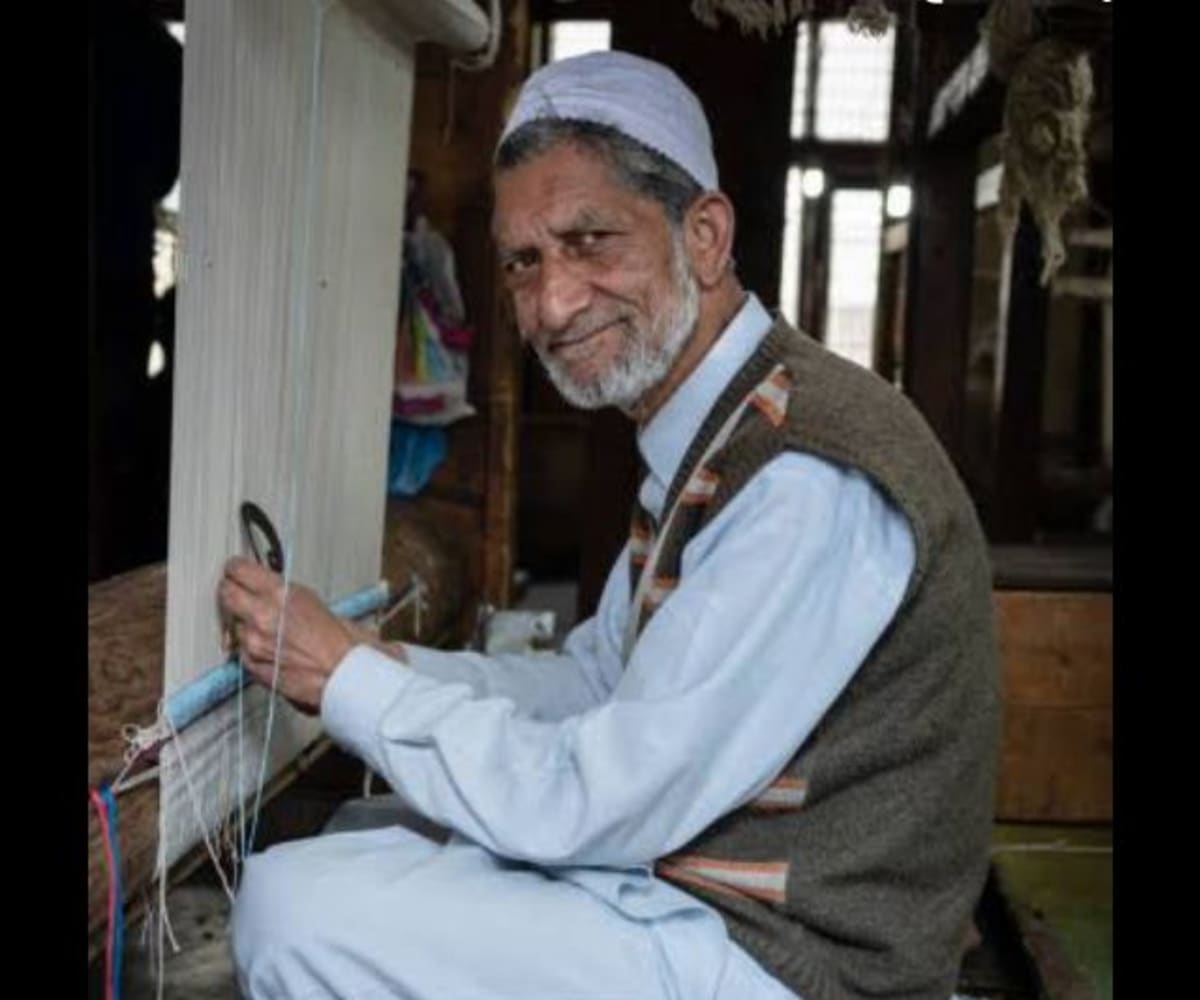
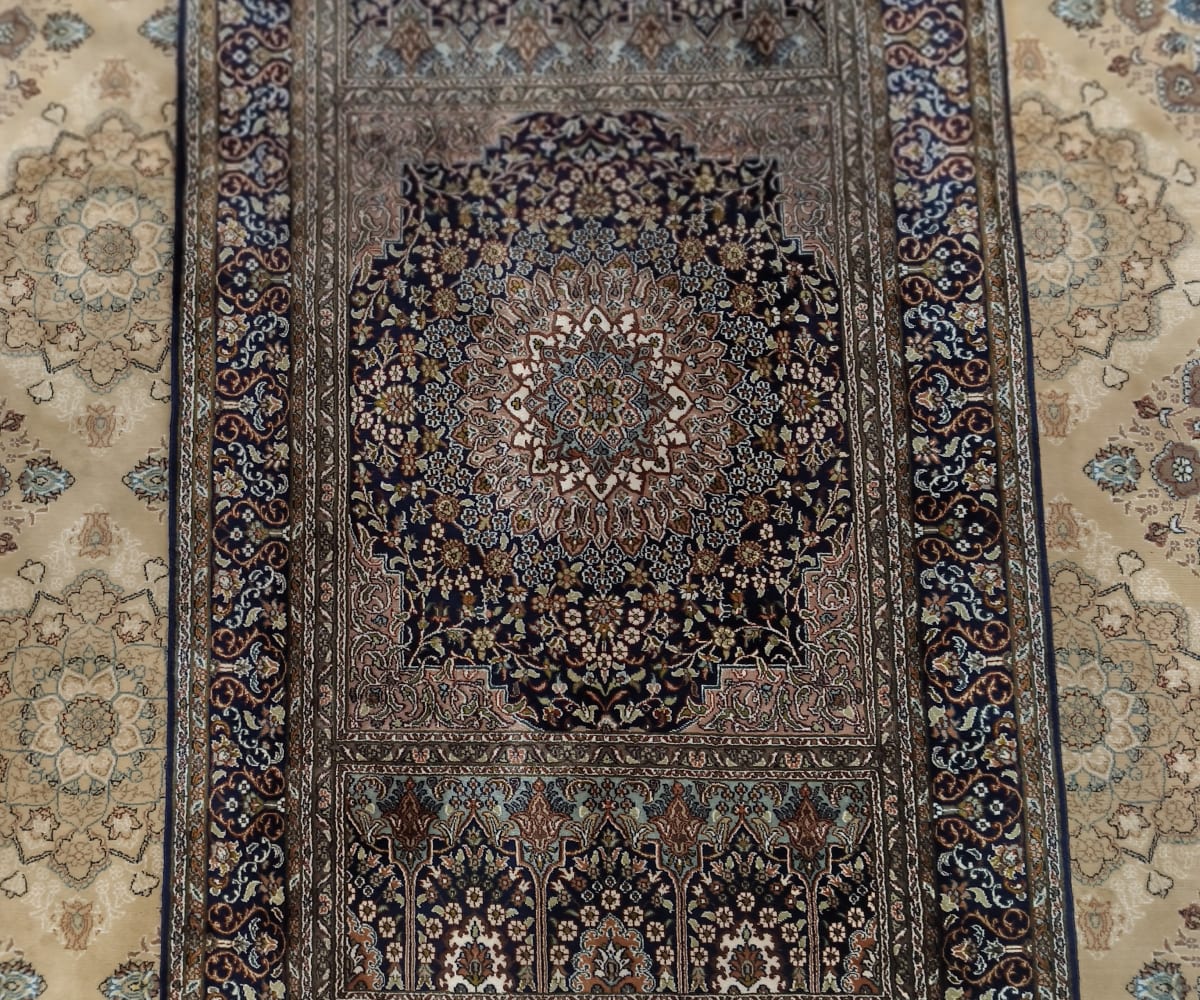
A machine-made carpet can be attractive, practical, affordable, and completely appropriate for a busy room. A handmade carpet can be deeply individual, repairable, culturally meaningful, and capable of ageing with unusual grace. Trouble begins only when one is presented as the other, or when vague words such as “hand-finished,” “heritage style,” and “artisan inspired” are allowed to blur the method of construction. The purpose of comparison is not to shame one category. It is to let the customer understand what they are paying for.
Two surfaces, two systems
A hand-knotted carpet is built on a foundation of warp threads held under tension on a loom. The weaver ties pieces of pile yarn around the warp, row after row, then secures and compacts the work with weft threads and a comb-like beater. The design emerges as the structure grows. In Kashmir, the process may be guided by a talim, a coded system that communicates design and colour instructions. The official Indian handicrafts description of Kashmiri hand-knotted carpet identifies the Persian Sehna or Sinneh knot tradition and notes that carpets can take an exceptionally long time to complete.
Machine-made carpets are produced through mechanised systems designed for speed, repeatability, and scale. Depending on the process, pile may be woven or tufted into a primary backing and then stabilised with additional materials. A design can be reproduced across many sizes and units with close consistency. That efficiency is not a moral failure. It is the reason machine-made carpets can furnish hotels, rentals, offices, and family rooms at accessible prices. But the customer should not pay a hand-knotted price for a machine-produced structure merely because the pattern resembles a traditional medallion.
Reading the back
The back of a carpet often speaks more clearly than the front. On many hand-knotted carpets, the pattern is visible on the reverse because the knots belong to the carpet's construction. The reverse may reveal small, natural variations in line, spacing, and colour placement. You may be able to trace motifs from front to back. Machine-made pieces often show a highly regular reverse, a backing layer, or a construction in which the relationship between the face and back is less direct. However, no single clue should be treated as universal; machine methods vary, and deceptive finishing can conceal evidence.
Fringe is another useful point of examination. In a traditional hand-knotted carpet, the fringe is generally an extension of the warp foundation. It is structurally continuous with the carpet. On many machine-made carpets, fringe is added after production for appearance. A sewn-on fringe does not make a carpet bad, but it changes what it is. Check where fringe meets the body. Look gently rather than pulling. If buying remotely, request clear photographs of the back, edge, fringe attachment, and a folded corner. A serious seller should understand why these views matter.
Variation, precision, and the human hand
People often say that imperfections prove a carpet is handmade. That phrase is only partly useful. Hand-knotted work can contain minute differences because a person maintains tension, reads instructions, changes yarn, and responds to the growing textile. Yet experienced weaving is precise. Borders should feel intentional. Motifs should have rhythm. The carpet should lie properly after finishing. A wildly distorted field is not automatically charming, and a beautifully controlled carpet does not become suspicious merely because its maker was highly skilled.
Machine production excels at exact repetition. Repeated motifs can be nearly identical, lines can be extremely uniform, and colour placement can remain constant across large runs. That character may suit contemporary interiors that demand predictable specification. Handmade work offers a different kind of order: the coherence of a design interpreted through sustained attention. Seen closely, one flower may differ slightly from its neighbour. Seen as a whole, the carpet can feel alive because its order is not sterile.
“The reverse of a carpet is not the less beautiful side. It is the page on which its construction can be read.”
Time, labour, and why prices diverge
The price of a hand-knotted carpet is shaped by more than a knot count. Knot density matters because it affects the level of detail possible and often the time required, but material, size, design complexity, yarn preparation, colour, weaving quality, finishing, condition, and origin all matter too. Two carpets with a similar stated density may differ greatly in artistic balance and execution. A fine silk carpet with complex curves asks something different of the loom and weaver than a robust wool carpet intended for daily use.
Machine-made pricing follows a different economic logic: fibre type, manufacturing technology, brand, scale, finishing, distribution, and market demand. Production speed lowers the labour carried by each unit and allows identical designs to be repeated. For many buyers, this is exactly the advantage. The mistake is to assume that visual similarity means equivalent value. A printed reproduction of a painting may carry the image beautifully, but it is not the painted canvas. Likewise, a machine-made carpet can interpret a traditional design without carrying the same structure, time, or human authorship.
Ageing and repair
A well-made hand-knotted carpet is often capable of thoughtful repair because its structure can be understood and worked upon by a skilled restorer. Worn areas may be reknotted, edges secured, fringe addressed, and the pile carefully managed. Repair is not always inexpensive or invisible, and every intervention should be considered, but the possibility is part of why such carpets can remain in families for decades. Natural materials may develop a softer surface and a settled colour character that many owners value.
Machine-made carpets may perform very well for their intended lifespan, especially when materials and construction are chosen for demanding use. Yet certain backing systems, adhesives, and synthetic fibres can make meaningful repair impractical once deterioration begins. Replacement may be more economical than restoration. Again, that can be a rational choice. The buyer should simply know whether the purchase is meant to be used for a period and replaced, or cared for as a long-term object.
How to buy without being misled
Begin with direct questions. Is the carpet hand-knotted, hand-tufted, handloom woven, flat-woven, or machine-made? Those terms are not interchangeable. What forms the pile? What forms the foundation? Is there an applied backing? Is the fringe structural or attached? Where was it made? Can the seller show the reverse and edges? If the claim includes a Geographical Indication, certification, or named maker, what documentation supports that particular claim? Honest answers should become more specific as the purchase becomes more serious.
Be cautious of demonstrations designed to create urgency. A dramatic discount does not establish origin. A salesperson standing on a carpet does not establish durability. The phrase “one of a kind” may simply mean a shop has one unit in stock. With a handmade piece, uniqueness should arise naturally from the actual object: its size, colour movement, individual execution, and traceable identity. Ask for the serial code and insist that the code on your order documents matches the exact piece reviewed.
Choosing for the life of the room
The best carpet is not always the most expensive or densely knotted. A family room with children, pets, and frequent gatherings may be better served by a durable wool carpet with forgiving colour and a pattern that ages comfortably. A quiet formal space may suit a finer silk or silk-highlighted piece. A machine-made carpet may be the intelligent choice where frequent replacement, strict sizing, or a limited budget matters most. Good guidance begins with the room, not with the seller's desire to push a category.
At The Kashmir Knot, handmade carpets are offered by enquiry because one-size pieces deserve to be considered as actual objects, not abstract product listings. We can discuss dimensions, materials, close details, room suitability, and current availability before payment. Our goal is not to persuade every visitor that only handmade carpets are worthy. It is to make certain that when someone chooses handmade, they understand the patience, structure, and human authorship they are choosing.
Send us the carpet code and a photograph of your room. We can show the reverse, edge, fringe, and details, then explain whether the piece suits the traffic, scale, light, and atmosphere of the space.