Authenticity that travels with the carpet
A serious piece should leave with more than a receipt. Its code, material story, maker, care guidance, and documented journey should remain close to it.
- Piece
- TKK-K-014
- Craft
- Hand-knotted carpet
- Material
- Recorded with order
Authenticity is often presented as a seal placed at the end of a sale. We believe it begins much earlier, in the discipline of keeping a piece identifiable from the moment it enters the collection. A carpet should not become anonymous as soon as it leaves the loom. A shawl should not be reduced to a decorative product code. Records cannot capture every hour of work or every person involved, but they can protect the basic truth of an object: what it is, what is known about it, who contributed to it, and which claims can responsibly travel with it.
The serial code as a promise of specificity
Every serious conversation should refer to the exact piece being considered. This is why a serial code matters. Handmade carpets are often unique in size, colour movement, finishing, and small details. Even when two pieces follow the same design, they are not interchangeable in the way factory units are. The serial code connects photographs, dimensions, quoted price, availability confirmation, payment, packing, and aftercare to one object. It reduces the risk of a customer reviewing one carpet and receiving another that merely looks similar.
A code alone, however, is not provenance. It is the thread that holds the record together. The record should include the piece name or description, category, dimensions, stated material, relevant technique notes, purchase date, customer details needed for the order, and any specific observations agreed before dispatch. If the carpet has a condition note, unusual feature, or care requirement, that information belongs with the transaction rather than remaining in an informal conversation that may be lost.
A story note without storytelling excess
Customers often want to know the story of a handmade piece, and rightly so. The danger is that the desire for story can encourage invented precision: an exact number of months that was never recorded, a named village guessed from style, a family lineage assumed rather than documented, or a grand historical claim attached to an ordinary design. A responsible story note separates known information from informed context. It can explain the method, motif tradition, material, and human work without turning uncertainty into theatre.
Our story note is intended to be readable, personal, and honest. It can describe why the piece was selected, what character we see in its field and border, how its colours behave, and what kind of room may suit it. Where we have a reliable maker name or workshop connection, that can be included with permission. Where we do not, we say so. Respect for artisans is not served by inventing a picturesque biography. It is served by improving traceability and by acknowledging that many hands may contribute to preparing yarn, designing, weaving, washing, clipping, and finishing.
The maker's name should travel
For generations, valuable handmade objects have often carried the name of the merchant, collector, or house while the maker disappeared. The imbalance is so familiar that it can feel natural. We want to move in another direction. When a carpet's maker details are available and the person is comfortable being named, the carpet can carry a maker tag and a corresponding note in its records. The tag is not a luxury flourish. It is a modest act of memory.
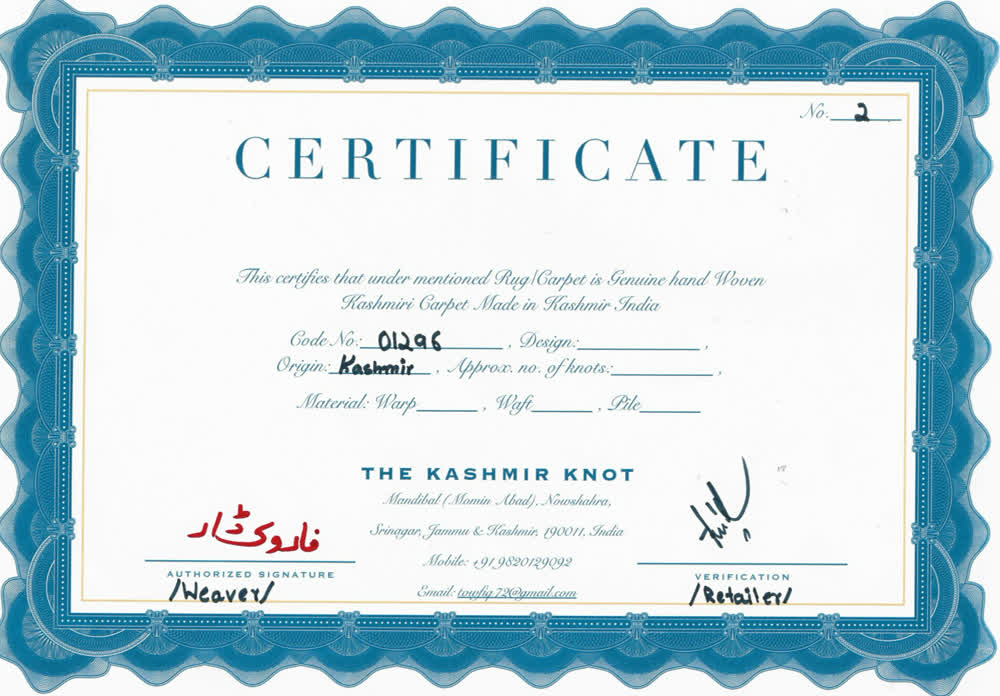
Imagine the carpet moving from Srinagar to a home in London, New York, Dubai, or Singapore, then being passed to another generation. Years later, the family may no longer remember the conversation in which it was purchased. A durable tag and kept certificate can return a name to the object. The owner can say not only, “This came from Kashmir,” but, “This was connected to Farooq Dar,” or another recorded artisan. That sentence does not capture the whole production chain, yet it is more human than silence.
“A maker's name does not make a carpet more handmade. It makes the human work harder to forget.”
What a certificate should do
A certificate should identify and document. It should not operate like a magical shield against all doubt. At minimum, a useful certificate or proof document can carry the house name, exact serial code, category, stated material, dimensions, purchase details, customer or recipient name where desired, and maker or workshop information where reliably recorded. It can reference photographs or a digital order record. It should be prepared for the exact piece, not photocopied as a generic statement that every item is rare, pure, or certified.
There is also an important distinction between a house-issued document and an independent or statutory certification. A certificate prepared by The Kashmir Knot records our representation and the details associated with the order. A Geographical Indication registration protects a recognised regional product category and its authorised use; it does not mean that any seller may call every object GI-certified without piece-specific support. Laboratory testing, government labels, and third-party assessments each have their own scope. Honest documentation names the source and limits of every claim.
GI, provenance, and the exact piece
Kashmir Pashmina and Kashmiri Hand Knotted Carpet are registered Geographical Indications in India. That recognition matters because it affirms a relationship among craft, geography, inherited knowledge, and reputation. It also creates a reason for sellers and buyers to take origin language seriously. Yet GI should not become another vague luxury word. The relevant question remains: what documentation or authorised marking applies to this exact piece, and what does that marking establish?
Provenance is broader than certification. It is the chain of information surrounding an object. A piece can have strong, honest provenance records even when a particular external certificate is not applicable. Conversely, a logo shown on a website cannot replace the need to identify the item actually being sold. We prefer to build trust through layers: clear serial codes, direct communication, close-up review, consistent order records, maker details where possible, careful packing references, payment matching, and aftercare that continues after delivery.
Digital records and physical memory
The most resilient system combines digital and physical records. Digital records help match enquiries, quotes, payment references, shipping details, and correspondence. Physical documents remain with the owner and can stay with the carpet even when email accounts or platforms change. The tag attached to or packed with a carpet should be discreet and designed so it does not damage the piece. The certificate and story note should be stored away from moisture and direct light, ideally together with purchase and care records.
Privacy matters within this system. A maker may want their name recognised without having personal contact details circulated. A customer may want their name printed on a certificate, or may prefer a gift recipient's name, or no personal name at all. Consent and restraint should guide the record. Provenance does not require publishing private information. It requires preserving the information that gives the object an accountable identity.
Authenticity after the sale
Documentation is most useful when it remains active. If an owner later asks about cleaning, repair, placement, or insurance records, the serial code and stored notes help return to the correct piece. If the carpet is gifted, inherited, or responsibly resold, its records can travel with it. Care decisions can then be made with better knowledge of material and construction. A repairer can understand what was originally stated, and the next owner receives more than an unsupported family story.
This is our ambition for authenticity at The Kashmir Knot: not a grand claim made once, but a relationship maintained. We want the customer's confidence to come from clarity before payment, a match between the reviewed and delivered piece, documentation that is careful about its claims, and a continued willingness to answer questions. The carpet's beauty begins the conversation. Its identity should remain after the conversation has moved into another home and another generation.
For a confirmed handmade carpet, ask us what maker, workshop, material, certificate, and story-note details can be recorded for that exact serial code. Where a maker name is available and consented to, we will help it travel with the piece.