From Persia to Kashmir, and then unmistakably Kashmiri
The carpet tradition did not arrive as a finished object frozen in time. It travelled through people, patronage, design knowledge, and the trade routes that joined Kashmir to wider worlds.
Popular memory often describes a single Silk Route carrying carpet weaving from Persia into Kashmir. The historical reality is richer: a web of mountain passages, courts, merchants, scholars, Sufis, and skilled migrants carried ideas across regions. Under Sultan Zain-ul-Abidin, Kashmir gave those ideas institutional support and a new local life.
To say that an art “came from Persia to Kashmir through the Silk Route” is evocative, but it can sound simpler than the past truly was. The Silk Route was not one road with a single beginning and end. It was a shifting network of trade and cultural exchange linking regions across Asia. Kashmir's mountain geography did not isolate it from those movements. It placed the valley within conversations among South Asia, Central Asia, Tibet, Kashmir, and beyond. Along these routes travelled not only silk, wool, dyes, and finished goods, but also techniques, motifs, manuscripts, languages, and people whose knowledge could take root in new places.
A valley connected to wider worlds
Kashmir has long held an unusual geographical and imaginative position. Enclosed by mountains yet connected by passes and river valleys, it developed local traditions while receiving outside influences. Traders and travellers brought materials and objects that invited comparison and adaptation. Scholars and spiritual figures moved with texts and ideas. Artisans carried practical knowledge that could not be transported in a chest: how to prepare a material, organise a workshop, read a design, control a tool, or teach an apprentice.
Persianate culture became especially influential across many courts and artistic centres in the region. “Persianate” does not mean that every object was made in Persia or that local traditions simply disappeared. It describes a broad cultural sphere in which Persian language, literature, courtly taste, garden imagery, manuscript arts, and workshop practices travelled and were reinterpreted. In Kashmir, these currents encountered an existing visual world shaped by the valley's plants, seasons, architecture, beliefs, and skilled communities. The result was not a copy. It was translation.
Zain-ul-Abidin and the value of patronage
Sultan Zain-ul-Abidin, remembered with affection as Bud Shah, ruled Kashmir for much of the fifteenth century. He is widely associated with a period of cultural, economic, and civic development. Official Indian handicrafts accounts identify his reign with the introduction and encouragement of Kashmiri hand-knotted carpet weaving, and describe Persian and Central Asian influence in the craft. Historical traditions also remember him as a patron who brought or supported skilled artisans and helped organise craft production.
Patronage matters because a craft cannot flourish through inspiration alone. Skilled people need materials, time, apprentices, markets, and conditions stable enough for knowledge to pass between generations. A ruler who values craft can create workshops, invite specialists, encourage training, commission difficult work, and make space for local artisans to absorb and transform unfamiliar techniques. Zain-ul-Abidin's importance in the story is therefore not that he personally invented Kashmir's carpet tradition. It is that his reign is remembered as an enabling moment when knowledge could be welcomed, organised, and made productive.
The loom as a place of translation
Imagine a technique arriving in a new region. The loom may be recognisable, the knot structure teachable, and the design language connected to Persian precedents. Yet every practical choice changes as local life enters the work. Available fibres and dyes affect colour and handle. A designer responds to flowers, leaves, gardens, and architecture seen nearby. A patron requests something suited to a Kashmiri room or a new market. A weaver interprets the design through learned habits and personal skill. Over years, the borrowed technique becomes locally fluent.
Kashmiri carpets are known for detailed floral and geometric compositions, wool and silk, and a knotting tradition associated with the Persian Sehna or Sinneh knot. The talim system is central to the craft's intellectual character. It translates a visual design into coded instructions that communicate colour and knot placement to weavers. This is more than a practical aid. It shows how design can live simultaneously as image, language, memory, mathematics, and coordinated labour.
“A route can carry a technique into a valley. Only generations of local hands can make that technique belong.”
Motifs that changed their accent
Carpet motifs often cross borders more easily than their meanings can be fixed. Medallions, vines, cypress forms, blossoms, arabesques, and garden arrangements appear across broad artistic geographies. In Kashmir, such forms found companionship with the valley's own visual abundance. The chinar leaf, lotus, almond or paisley-like forms, flowering branches, and garden sensibilities became part of an evolving vocabulary. A motif might retain a distant family resemblance while gaining a Kashmiri accent through colour, scale, spacing, and execution.
This is why authenticity should not be confused with cultural purity. Great craft traditions are rarely untouched by contact. Their authenticity lies in an honest relationship to place, practice, and community, not in pretending that no idea ever travelled. Kashmiri carpet weaving is authentic precisely because Kashmir received, studied, transformed, and sustained the art. The tradition honours its Persian and Central Asian connections without surrendering its local authorship.
From courtly support to household labour
Over centuries, carpet weaving moved through changing systems of patronage, trade, and household production. Workshops connected designers, talim writers, dyers, yarn preparers, weavers, washers, clippers, finishers, merchants, and patrons. Some work was visible; much remained hidden. The finished carpet could enter a palace, shrine, drawing room, or international market while the names of those who built it were rarely recorded. This history helps explain why present-day conversations about fair recognition and maker identity matter.
International demand brought opportunity and pressure. Markets encouraged extraordinary refinement, but they could also separate craft from the people who practised it. Design names and commercial categories sometimes travelled farther than artisan names. Mechanisation and imitation later introduced another challenge: a traditional-looking surface could be produced without the traditional structure or labour. The survival of hand-knotting has therefore depended not only on skill, but on customers and institutions willing to understand why the method matters.
The history visible in a modern carpet
When we look at a contemporary Kashmiri hand-knotted carpet, the fifteenth century is not sitting inside it unchanged. History is visible as accumulated practice. The loom structure, knotting method, talim knowledge, motif families, and workshop relationships carry memory. So do the choices made by a present-day weaver who has learned from teachers and adapted to current materials and customers. Heritage is active. It survives by being repeated carefully enough to remain recognisable and flexibly enough to remain alive.
This active heritage also asks for precision in the way a carpet is described. Not every floral carpet is Kashmiri. Not every Kashmiri carpet has a direct, documentable line to a particular court workshop. Not every traditional motif has a single origin story. Responsible history makes the object more interesting because it replaces a neat legend with a human network. It allows us to honour named patrons such as Zain-ul-Abidin while also remembering generations of unnamed artisans whose teaching made continuity possible.
A portrait of patronage
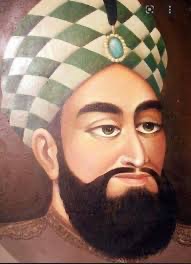
The portrait depiction presented with this essay honours Sultan Zain-ul-Abidin's remembered role as a scholarly, humane patron. It is included not to turn history into royal spectacle, but to give a face-shaped pause within a story usually told through objects. The deeper portrait is found in the cultural memory of a reign associated with bridges, public works, learning, tolerance, and crafts given room to flourish.
His legacy offers a useful lesson for the present. Craft prospers when society treats it as knowledge rather than decoration alone. A carpet is beautiful, but its beauty rests on systems of teaching, fair work, material access, patient demand, and respect. Patronage today may come from a collector, a family furnishing a home, a designer, an institution, or a careful retailer. Every serious purchase can help decide whether the next generation sees weaving as a viable inheritance or an impossible sacrifice.
The route continues
The old trade networks changed, but the journey continues. A carpet now travels through photographs, video calls, digital catalogues, payment systems, aircraft, and couriers. Its movement is faster than the movement of ideas and artisans in the fifteenth century, yet the essential question remains: what travels with it? If only the object moves, history becomes decoration. If the technique, maker's name, care knowledge, and honest story move too, the carpet arrives with a fuller identity.
The Kashmir Knot stands within that continuing route. We do not claim to own the history, and we do not wish to flatten it into a sales line. Our role is to select carefully, describe responsibly, keep the exact piece identifiable, and help customers understand what kind of work they are welcoming into their homes. From Persia and Central Asia to Kashmir, from the loom to the room, the art has always depended on connection. Its future will depend on the quality of that connection.
We acknowledge the Persian and Central Asian currents within Kashmiri carpet history while honouring the local designers, talim writers, dyers, weavers, and finishers who made the tradition unmistakably Kashmiri.